
Does Big Walk have proximity chat?
Yes — Big Walk proximity chat is the default voice system. Volume scales with distance, echoes in valleys, muffles through walls, and routes through walkie talkies when equipped.

Big Walk proximity chat guide: distance falloff, wall muffling, walkie static, arm gestures, text chat, and mute-puzzle relay habits for co-op squads.
Big Walk proximity chat fades with distance, echoes in valleys, and muffles through walls — walkie talkies and arm gestures extend reach when puzzles split the party. This official overview shows the walker-talker loop.
~10 min read
Sponsored
Big Walk proximity chat is the spine of every puzzle: voices get louder when you stand close, fade across distance, echo in valleys, muffle through walls, and crackle when routed through walkie talkies. House House and Panic built Big Walk as a walker-talker — not a shooter with optional voice — so this Big Walk communication guide covers falloff behavior, arm gestures, optional text chat, and relay habits before you enter rooms that deliberately break normal talk. Verified August 16, 2026 · Steam.
| Fact | Detail |
|---|---|
| Voice type | Proximity voice — volume scales with distance |
| Falloff | Quieter across ridges; louder when standing shoulder-to-shoulder |
| Environment | Echo in corridors; muffled through walls and doors |
| Tool override | Walkie talkies add radio static; megaphones extend shout range |
| Gestures | Arm wave, point, carry — required in mute segments |
| Text chat | Available for accessibility and quiet sessions |
| Players | 2–12 players · invite friends · no random matchmaking |
| Combat | None — communication is the gameplay |
Big Walk proximity chat mimics a real hike: you hear friends clearly when they are next to you and barely hear them on the far side of a ravine. There is no global voice channel — every word travels through the game world with distance and geometry, which is why House House calls Big Walk a walker-talker instead of a standard co-op adventure with always-on squad comms.
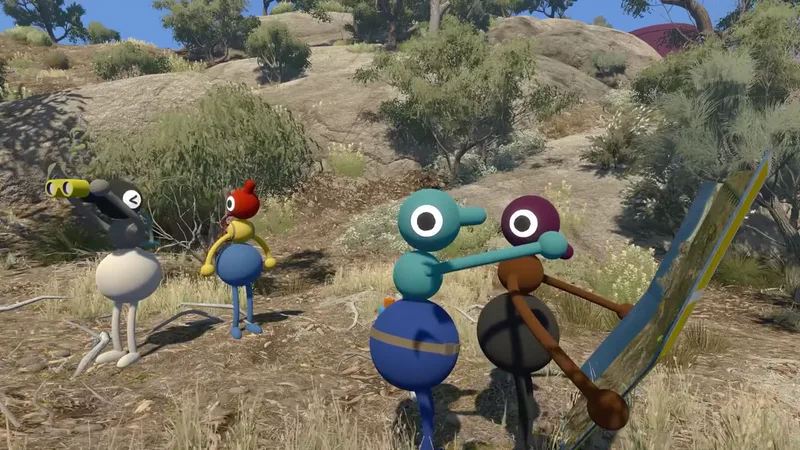
| Distance / terrain | What teammates hear |
|---|---|
| Same beach, face-to-face | Full volume — ideal for planning and code relay |
| Same ridge, ten meters apart | Noticeably quieter; lean in or move closer |
| Opposite sides of a wall | Muffled — words lose clarity even if volume remains |
| Valley floor vs cliff top | Echo and drop-off; megaphone or walkie recommended |
| Separate puzzle rooms | Often silent unless a walkie or radio link exists |
| Walkie talkie active | Radio-filtered voice at long range with static crackle |
Several puzzles gate progress on hearing someone faintly down a corridor or only catching every third digit through a wall. If your group routes all communication through a third-party voice app at full volume, those beats feel broken — because the design assumes you experience attenuation. Keep in-game proximity voice unmuted for at least the tutorial hour, even if you banter on platform party chat between sessions.
Small groups of two to four often prefer open mic on the beach — it matches the hang-out tone of the game. Larger groups of six to twelve benefit from push-to-talk so background keyboards and snacks do not flood the valley. Big Walk exposes voice mode in settings; agree on one approach before entering the first mute puzzle so nobody toggles mid-room.
When distance alone breaks clarity, tool toys extend your voice — covered next.
Proximity voice covers planning on flat ground. The moment someone climbs a separate tower leg or drops into a lower ravine, grab a walkie talkie from the tools guide before they leave earshot. Megaphones fill the gap between walkie range and normal shouting across open terrain.
| Situation | Use this | Why |
|---|---|---|
| Scout on ridge, caller in valley | Walkie talkie (both players) | Radio link bypasses vertical falloff |
| Open field, no walkies yet | Megaphone | Extends shout range without full radio setup |
| Radio transmitter puzzle room | Walkie + fixed receiver | Someone must stand at the receiver to hear the transmitter mic |
| Party split three ways | Two walkies + one megaphone caller | Assign roles before entering — swapping mid-puzzle wastes time |
| Lost player, no voice | Flare first, then walkie ping | Visual signal beats shouting into a canyon |
| Gesture-only segment ahead | Stow megaphone — arms only | Some rooms disable all voice tools on purpose |
Both players need a walkie for a private radio link. Voice picks up a deliberate static filter — House House treats it as part of the atmosphere, not a low-quality bug. Walkies appear early in the tutorial zone and at camps near colored towers; coordinate pickup in the beginner guide before the first major bridge split.
Megaphones dramatically extend how far a spoken call carries without replacing proximity chat entirely. They suit river crossings and wide puzzle yards where walkies are not unlocked yet. They do not help through solid walls — for that, send a runner or use laser pointing from the tools page.
When voice is disabled entirely, arm gestures become the language — next section.
Matched by build plan, shared topics, and guide progression — not random related links.
Big Walk ships an Arms control layer — point, wave, carry teammates, and exaggerated mime — for segments where talking is muted or unreliable. The official tagline literally lists "Arms!!" beside proximity voice because some relay rooms expect gesture-only coordination.

| Gesture | Best use |
|---|---|
| Point / laser aim | Mark a distant switch, tower color, or beach landmark |
| Wave | Confirm someone saw your call across a gap |
| Carry / piggyback | Move a stuck friend or reach high ledges together |
| Exaggerated mime | Spell digits or directions when voice is fully off |
| Rhythm clap / cowbell | Synchronize timing puzzles with audible beats |
| Nose wiggle (mic active) | Silent confirmation that your mic works |
The opening zone teaches arm controls before the first tower gate. Skipping gesture practice because your Discord call is clear sets you up to fail the first mime relay. Spend two minutes waving at each other while proximity voice is still on — muscle memory matters when voice drops.
Laser pointers mark what words cannot reach; binoculars let a scout describe what the valley group must point at. Cowbells and rhythm segments appear in busy slopes where six players share one narrow path — treat them as timing signals, not jokes only.
Text chat remains an accessibility backstop when arms or voice are not viable — details below.
Yes — Big Walk includes optional text chat alongside proximity voice. It exists for accessibility, crossplay friends with broken mics, and quiet sessions where open voice is impractical. Text does not replace falloff puzzles that expect you to hear distance — but it is a legitimate relay channel for code digits and directions when your group agrees to use it.
Steam, PS5, and Switch 2 players can mix in one session — see the multiplayer guide for invites. Platform party chat works for out-of-game banter, but mute one layer to prevent echo. Text chat inside Big Walk keeps relay digits visible for players who cannot hear a faint walkie crackle.
Big Walk ships rebinds, hold/toggle options, FOV and motion reduction, and challenge skips for hearing, reading, reaction, or fine-motor needs. Hosts should sync skip preferences in the opening minutes — a surprise skip mid-puzzle changes whether text or voice is the fair channel.
Some rooms still restrict all channels on purpose — that is where mute-puzzle habits matter.
Mid-campaign Big Walk puzzles sometimes disable proximity voice, walkies, or both. Treat those rooms as signal puzzles: assign roles before entry, agree on gesture vocabulary, and keep a flare carrier outside for recovery if someone walks the wrong tunnel.
| Room signal | Team response |
|---|---|
| Voice icon crossed out on entry | Arms-only until exit — no megaphone workaround |
| Walkie static but no words | Check if room blocks radio; switch to runner relay |
| One viewer, many actors | Viewer gets binoculars; actors get lasers and whiteboard |
| Digit relay with echo | One caller, one repeater — no parallel shouting |
| Timed gate after mime | Practice sequence outside before committing |
| Player missing after mute segment | Flare at last seen door; regroup before retry spam |
The fastest mute-room failure mode is three people trying to lead at once. Pick one caller who sees the code, one runner who acts on switches, and one floater who watches for soft-lock triggers. Repeat digits slowly — echo makes "fifteen" sound like "fifty" across a valley.
This page stays spoiler-light on individual room layouts. For type-by-type habits — relay, rhythm, whiteboard copy, split-path — continue to the puzzles guide after you stock tools from the tools and items page.
Mic settings below reduce false "broken voice" reports before you blame puzzle design.
Proximity voice only works if the game receives clean input. Use these starting values, then adjust after the beach mic test.
| Setting | Recommended start | Notes |
|---|---|---|
| Input device | Dedicated headset mic | More stable than laptop speakers feeding back |
| Voice mode | Open mic (2–4 players) | Push-to-talk for 6+ or noisy rooms |
| Proximity volume | 75–90% | Nearby voices clear without drowning ambience |
| Dialogue vs music | Dialogue higher | Music is pretty — relay digits are progress |
| Platform party | Muted or push-to-talk | Prevents double audio with in-game voice |
| Push-to-talk bind | Easy reach key / bumper | Relay rooms need fast unmute |
If teammates hear you but you hear nothing, check output device and whether PlayStation or Nintendo voice privacy settings block crossplay chat. If nobody hears anyone, confirm the game has microphone permission on Mac or Windows. Reboot the session once before anyone creates a duplicate save — most "broken multiplayer voice" tickets are device selection, not server outages.
House House wants groups to experience distance, echo, and walkie crackle as part of the hike. Cranking every volume slider to 100% does not replace moving closer or picking up tools. When falloff feels harsh, that is often the puzzle asking you to reposition — not a settings bug.
Next stop for most squads: equip walkies, lasers, and flares on the tools and items guide before the first major split-path tower.
Yes — Big Walk proximity chat is the default voice system. Volume scales with distance, echoes in valleys, muffles through walls, and routes through walkie talkies when equipped.
Yes — optional text chat exists for accessibility and relay digits. Some puzzles still expect proximity voice or gestures by design.
There is no official Big Walk Discord. Fan servers exist, but House House asks groups to prefer in-game proximity voice/text for puzzle integrity. Party chat still works for banter — keep proximity unmuted for puzzle segments. See updates.
Quiet microphones are calibrated louder at close and medium range; the distance voices drop off is unchanged. Patch notes: updates.
Both players carry a walkie for a radio link with static filter. They bypass distance falloff but not every mute room — see the tools guide for pickup locations.
Point, wave, carry, and mime replace voice in restricted segments. Practice on the tutorial beach before the first bridge.
That is intentional falloff — move closer, use a megaphone, or hand them a walkie. Vertical separation is the hardest case for proximity voice.
Stock tools on the tools and items page, then open the puzzles guide before voice-restricted tower rooms.
August 16, 2026
Matched by build plan, shared topics, and guide progression — not random related links.